
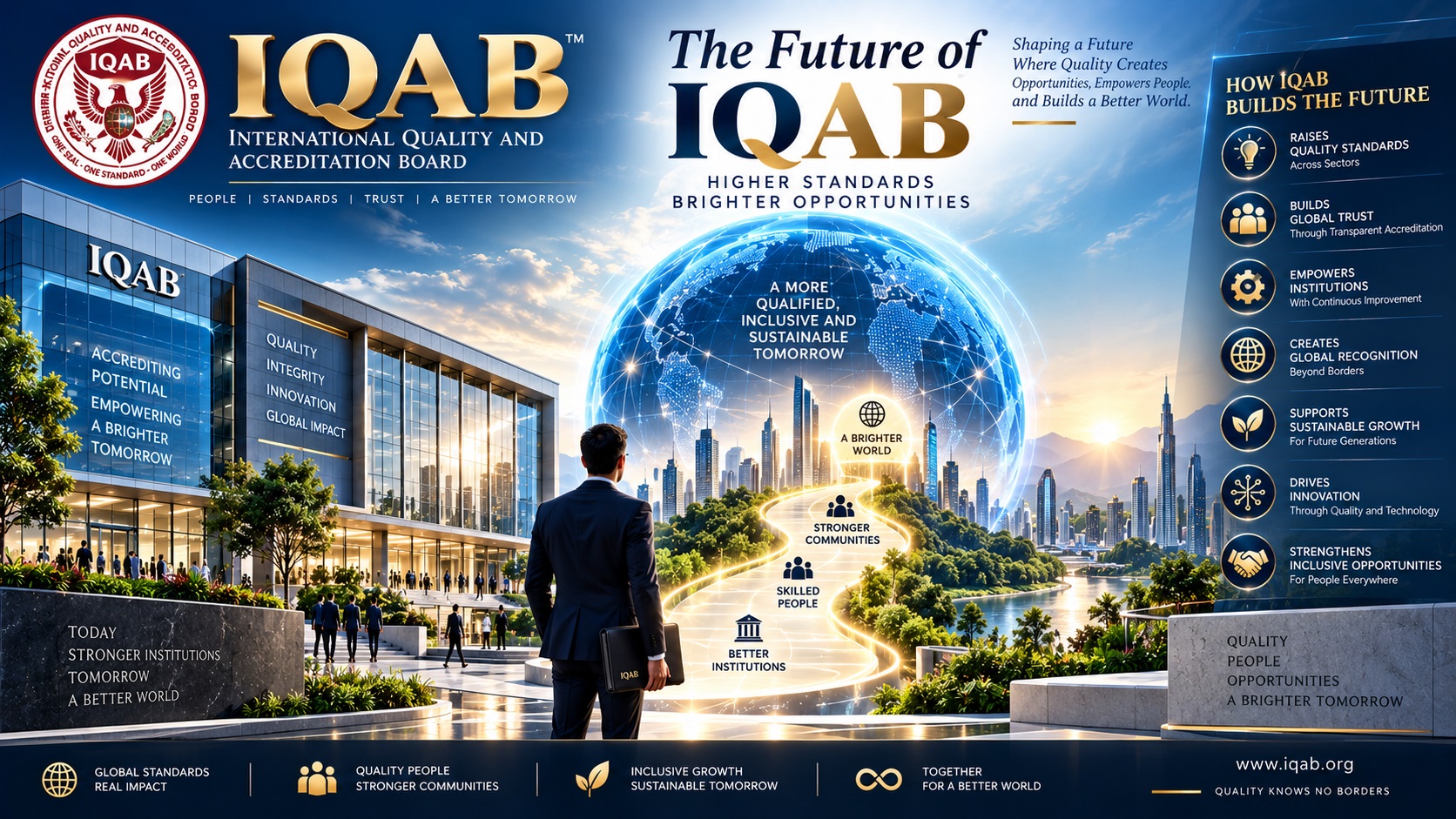
IQAB and the Future of Smart Accreditation Ecosystems
Architecting Autonomous Compliance, Decentralized Verifiable Trust, and AI-Driven Quality Grids for Industry 5.0
1. The Genesis of Smart Accreditation: Beyond Fragmented Compliance
For decades, conformity assessment frameworks operated under a centralized, siloed model: individual accreditation bodies (ABs) accredited conformity assessment bodies (CABs), which in turn certified organizations via periodic onsite audits. While this hierarchical structure brought baseline uniformity in the 20th century, it is buckling under the weight of modern digital commerce.
Three fundamental shifts necessitate the transition to Smart Accreditation Ecosystems:
2. Architectural Pillars of the IQAB Smart Accreditation Ecosystem
IQAB establishes an open, interoperable, and modular architecture that transforms quality assurance into a participatory, real-time trust fabric. The framework rests on five foundational architectural pillars:
3. Evolutionary Matrix: Legacy Accreditation vs. IQAB Smart Ecosystem
The following matrix outlines the fundamental architectural and operational advancements brought by the IQAB Smart Accreditation Ecosystem:
|
System Characteristic |
Legacy Accreditation Model |
IQAB Smart Ecosystem |
Strategic Impact |
|---|---|---|---|
|
Network Topology |
Centralized, hierarchical, bilateral |
Decentralized, federated trust grid |
Resilient; no single point of failure |
|
Verification Speed |
Manual lookups, paper registries (Days/Weeks) |
Cryptographic instant proof (<100ms) |
Immediate supply chain & border clearance |
|
Audit Mechanism |
Manual sampling & retrospective paperwork |
Continuous automated data oracles & telemetry |
Zero-blind-spot real-time compliance |
|
Governance Execution |
Static checklists & periodic renegotiations |
Self-executing smart compliance contracts |
Automated enforcement & dynamic mitigation |
|
AI & Digital Systems |
Unmonitored or treated as external tools |
Native continuous algorithmic audits |
Guaranteed safety, robustness, and trust |
4. Ecosystem Efficiency & Risk Benchmarks
Cross-industry simulations and pilot deployments of the IQAB Smart Ecosystem across global supply chain networks, semiconductor fabrication, and fintech consortia demonstrate exponential improvements across critical operational metrics.
| Certificate Verification Delay | Multi-Market Audit Friction | Compliance Operational Cost | Risk Anomaly Interception | Data Integrity Assurance | |
|---|---|---|---|---|---|
| Legacy Accreditation Baseline | 100 | 100 | 100 | 36 | 45 |
| IQAB Smart Accreditation Ecosystem | 2 | 24 | 31 | 96 | 99 |
5. Industry-Specific Smart Ecosystem Deployments
The versatility of the IQAB Smart Ecosystem architecture enables bespoke deployment patterns tailored to high-consequence global sectors:
6. Strategic Blueprint: Joining the IQAB Smart Grid
For institutions, regulatory agencies, and enterprise leaders, onboarding into the IQAB Smart Accreditation Ecosystem follows a structured four-stage pathway:
Phase 1: Digital Identity & DID Integration (Months 1–2)
Provision enterprise decentralized identifiers, map authorization policies, and integrate secure cryptographic key management infrastructure.
Phase 2: Telemetry Pipeline & Smart Oracle Deployment (Months 3–4)
Connect ERP, QMS, and IoT streams to secure compliance oracles, creating dynamic data feeds for automated compliance checks.
Phase 3: Smart Contract Policy Configuration & Simulation (Months 5–6)
Calibrate automated certification triggers, dynamic audit thresholds, and multi-tier alerting mechanisms within the IQAB testing sandbox.
Phase 4: Full Federation & Global Verification (Ongoing)
Achieve live federated accreditation, enabling instant verifiable credentials across all international trade corridors and regulatory partner networks.