
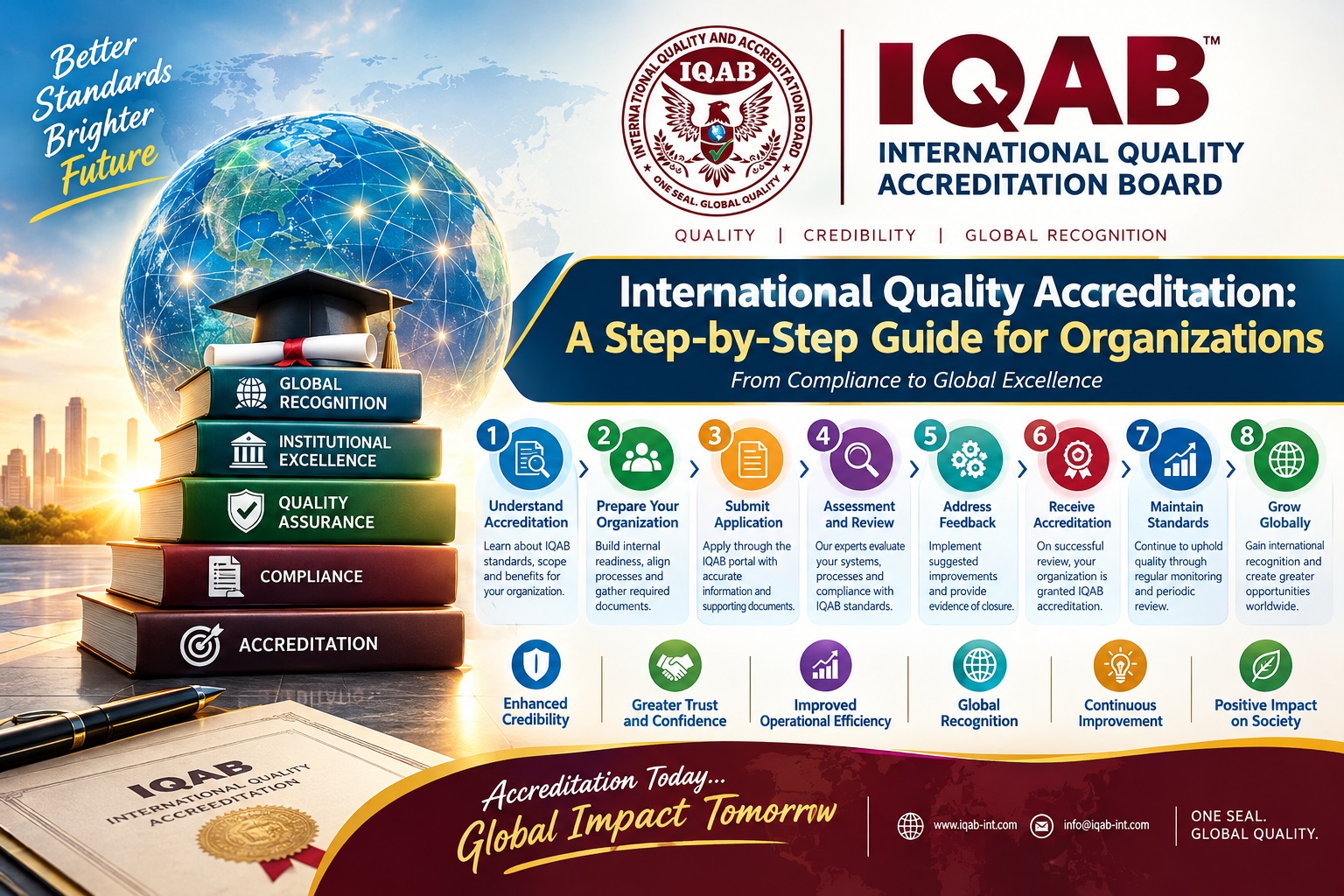
International Quality Accreditation | A Step-by-Step Guide for Organizations
A Strategic and Operational Roadmap for Attaining, Sustaining, and Maximizing Value from Global Quality Accreditation Frameworks
Document Focus: Organizational Quality Accreditation & Certification Strategy
Target Audience: Executive Leadership, Quality Directors, Higher Education Deans, Professional Bodies & Regulators
Methodology: 8-Phase Structured Implementation Framework, Gap Analysis, Evidence Architecture & Continuous Improvement
Table of Contents
2. The Global Accreditation Landscape: Typology and Strategic Alignment
2.1 Professional Body & Licensure Accreditations
2.2 Higher Education & Business School Accreditations
2.3 Institutional & Specialized Quality Accreditations
3. The 8-Phase Step-by-Step Accreditation Roadmap
Phase 1: Strategic Scoping, Governance Alignment & Chartering
Phase 2: Comprehensive Diagnostic Gap Analysis
Phase 3: Policy Engineering, Governance Restructuring & Quality Systems
Phase 4: Evidence Architecture & Self-Evaluation Report (SER) Authoring
Phase 5: Internal Auditing, Mock Peer Review & Red-Team Assessment
Phase 6: The Formal External Peer Review & On-Site Evaluation Visit
Phase 7: Response to Findings, Remediation & Decision Management
Phase 8: Continuous Quality Improvement (CQI) & Cyclical Maintenance
4. Master Implementation Matrix and Milestone Timeline
5. Resource and Effort Allocation Across the Accreditation Lifecycle
6. Critical Pitfalls to Avoid in the Accreditation Journey
1. Executive Summary: The Strategic Imperative of Global Accreditation
In an era defined by global competition, hyper-specialized talent demands, and heightened consumer and regulatory scrutiny, organizations across education, professional services, healthcare, and enterprise sectors must demonstrate verified excellence. International quality accreditation serves as the ultimate institutional credential—a rigorous, third-party validation that an organization's governance, processes, educational curriculums, or operational outcomes meet demanding global benchmarks.
Attaining international accreditation is not merely a ceremonial badge; it is a transformative organizational journey. When executed strategically, accreditation enhances institutional reputation, drives operational efficiency, unlocks international mobility and reciprocity compacts, attracts top-tier talent and students, and creates an enduring culture of continuous quality improvement.
However, the path to accreditation is complex, resource-intensive, and demanding. Organizations frequently struggle with fragmented data, cultural inertia, inadequate governance documentation, and misunderstandings of evaluative rubrics. This comprehensive guide provides an authoritative, 8-phase operational roadmap designed to guide executive leadership and quality assurance teams from initial scoping through post-audit continuous improvement.
2. The Global Accreditation Landscape: Typology and Strategic Alignment
Before embarking on the accreditation journey, leadership must understand the diverse taxonomy of global accreditation frameworks and select the standard that aligns precisely with their strategic mission:
2.1 Professional Body & Licensure Accreditations
Focused on qualifying professionals for statutory practice, cross-border reciprocity, and public trust (e.g., AICPA/NASBA IQAB, IFAC Statements of Membership Obligations, Royal Charter bodies, ABET for engineering, and medical licensing councils). These bodies audit competency benchmarks, examination psychometrics, and practical ethics.
2.2 Higher Education & Business School Accreditations
Focused on academic quality, research impact, curriculum innovation, and student learning outcomes (e.g., AACSB, EQUIS, AMBA, and regional university accreditors). These bodies evaluate faculty qualifications, strategic mission fulfillment, and pedagogical assurance.
2.3 Institutional & Specialized Quality Accreditations
Encompassing specialized healthcare accreditations (e.g., Joint Commission International - JCI), laboratory testing recognitions, and industry-specific excellence awards that validate patient safety, technical precision, and operational governance.
3. The 8-Phase Step-by-Step Accreditation Roadmap
Achieving international accreditation requires a disciplined, multi-year program management approach. Below is the step-by-step execution framework:
Phase 1: Strategic Scoping, Governance Alignment & Chartering
The foundation of a successful accreditation program begins at the board and executive leadership level:
Phase 2: Comprehensive Diagnostic Gap Analysis
Before generating application documents, the organization must perform a rigorous, honest baseline audit against every standard and criterion of the accrediting agency:
Phase 3: Policy Engineering, Governance Restructuring & Quality Systems
Accreditation bodies require proof of institutionalized, repeatable quality management systems rather than ad-hoc operational practices:
Phase 4: Evidence Architecture & Self-Evaluation Report (SER) Authoring
The Self-Evaluation Report (SER) or Self-Study Dossier is the primary document evaluated by the accreditation review panel. Quality of evidence is paramount:
Phase 5: Internal Auditing, Mock Peer Review & Red-Team Assessment
Simulating the external evaluation environment is the most effective technique for uncovering blind spots:
Phase 6: The Formal External Peer Review & On-Site Evaluation Visit
The on-site (or comprehensive virtual) visit is the culminating moment of the evaluation lifecycle:
Phase 7: Response to Findings, Remediation & Decision Management
Following the visit, the organization receives the formal Draft Peer Review Report:
Phase 8: Continuous Quality Improvement (CQI) & Cyclical Maintenance
Accreditation is a continuous state of institutional discipline, not a one-time event:
4. Master Implementation Matrix and Milestone Timeline
The following master implementation matrix outlines the core deliverables, responsible stakeholders, and estimated duration across all eight phases of the accreditation lifecycle:
|
Phase |
Core Strategic Objective |
Key Deliverables |
Lead Responsibility |
Timeline Window |
|---|---|---|---|---|
|
Phase 1: Scoping & Chartering |
Establish strategic mandate and resources |
Accreditation Charter, Steering Committee, Approved Budget |
Board of Directors & Executive Leadership |
Months 1 – 3 |
|
Phase 2: Diagnostic Gap Analysis |
Identify institutional compliance gaps |
Gap Matrix, Risk Prioritization, Remediation Plan |
Chief Quality Officer & Department Leads |
Months 3 – 6 |
|
Phase 3: System Engineering |
Institutionalize policies & data systems |
Standard Operating Procedures, Assessment Tools, CQI Loops |
Operations, Academic Senate & IT Directors |
Months 6 – 12 |
|
Phase 4: Evidence & SER Authoring |
Produce comprehensive Self-Study Dossier |
Self-Evaluation Report (SER), Digital Evidence Repository |
Accreditation Lead & Faculty/Staff Taskforces |
Months 12 – 18 |
|
Phase 5: Mock Review & Red-Team |
Validate audit readiness and train stakeholders |
Mock Audit Report, Stakeholder Training, Gap Closure |
External Consultant Panel & Steering Committee |
Months 18 – 20 |
|
Phase 6: External Peer Review |
Host site visit and demonstrate compliance |
Site Visit Schedule, Reviewer Dossier, Exit Briefing |
Executive Leadership, Quality Team & All Staff |
Months 20 – 22 |
|
Phase 7: Decision Management |
Respond to report and secure accreditation |
Formal Institutional Response, Supplementary Evidence |
CEO / President & Chief Quality Officer |
Months 22 – 24 |
|
Phase 8: Continuous Improvement |
Sustain standards and prepare for renewal |
Annual Monitoring Reports, Ongoing KPI Dashboards |
Institutional Quality Office & Unit Directors |
Ongoing (Years 2 – 5+) |
5. Resource and Effort Allocation Across the Accreditation Lifecycle
Achieving accreditation requires a dynamic distribution of organizational bandwidth. As illustrated below, Phase 3 (System & Policy Engineering) and Phase 4 (Evidence Dossier Authoring) represent the peak resource-intensive periods, demanding up to 55% of the total cumulative organizational effort.
| 1. Scoping | 2. Gap Audit | 3. Systems | 4. Dossier | 5. Mock Review | 6. Site Visit | 7. Remediation | 8. Maintenance | |
|---|---|---|---|---|---|---|---|---|
| Organizational Effort Share (%) | 8 | 12 | 25 | 30 | 10 | 5 | 4 | 6 |
6. Critical Pitfalls to Avoid in the Accreditation Journey
7. Executive Action Checklist & Conclusion
International quality accreditation is one of the most powerful catalysts for organizational transformation. By establishing transparent benchmarks, robust data governance, and an unrelenting commitment to stakeholder value, accredited organizations position themselves as global leaders in their respective fields.
Executive Readiness Checklist for Leadership:
✔ Has the Governing Board formally approved the accreditation strategy and multi-year budget?
✔ Is the Quality Accreditation Steering Committee actively meeting with cross-functional leadership?
✔ Has a thorough, unvarnished diagnostic gap analysis been completed and prioritized?
✔ Are operational and academic policies codified, approved, and accessible in a central repository?
✔ Is the digital evidence repository populated with indexed, verifiable primary source artifacts?
✔ Has an independent mock review been executed with simulated stakeholder interviews?